

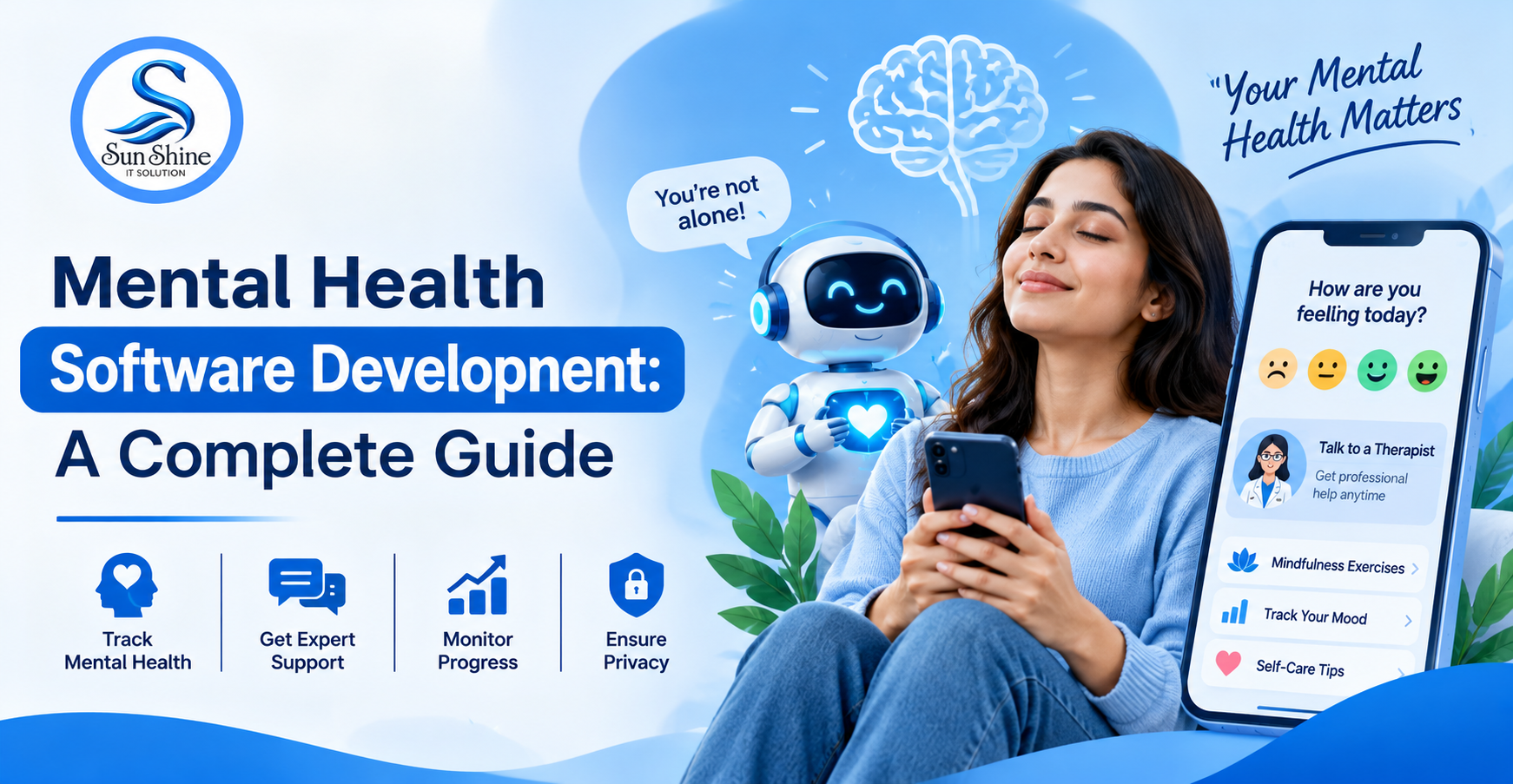
In this complete guide, we will explore mental health software development, its features, benefits, types, technologies, development process, and how businesses can build their own mental health applications.
1. What Is Mental Health Software Development?
Mental health software development is the process of designing and building digital applications that help healthcare professionals and organizations manage mental health services, patient information, therapy sessions, appointments, and communication.
These applications can be developed for web platforms, Android devices, and iOS devices, depending on business requirements.
Mental health software can support different activities, including:
- Patient registration and profile management
- Online therapy and counseling sessions
- Appointment scheduling
- Therapist and psychologist management
- Digital patient records
- Mental health assessments
- Progress tracking
- Medication and treatment records
- Secure messaging and communication
- Reports and analytics
For example, a mental health clinic can use custom software to register patients, schedule appointments, manage therapist availability, maintain consultation records, and monitor treatment progress.
Similarly, an online therapy business can develop a mobile application that allows users to discover therapists, book virtual sessions, communicate securely, and manage their appointments.
Custom mental health software makes it possible to build a digital platform according to the specific requirements of healthcare providers and mental wellness businesses.
2. How Does Mental Health Software Work?
Mental health software works by connecting patients, therapists, psychologists, counselors, and administrators through a centralized digital platform.
The exact workflow depends on the type of application, but a typical mental health platform follows these steps.
Step 1: User Registration
Patients create an account by providing basic information such as their name, email address, contact details, and other required details.
The application can also include secure login, password recovery, and account verification.
Step 2: Patient Profile Creation
After registration, users can complete their profiles with relevant information, preferences, and optional intake questionnaires.
Healthcare providers can maintain patient profiles and authorized clinical information through the management dashboard.
Step 3: Therapist Selection
Patients can browse available therapists, psychologists, or counselors according to their preferences.
The application can display professional profiles, qualifications, areas of specialization, languages, availability, and consultation details.
Step 4: Appointment Booking
Patients can select an available therapist and book an appointment according to the displayed schedule.
The system manages appointment confirmations, rescheduling, cancellations, and reminders.
Step 5: Online Consultation
If the platform supports teletherapy, patients can attend online sessions through integrated video or audio communication features.
Therapists can conduct consultations remotely through supported devices.
Step 6: Session Documentation
Authorized healthcare professionals can maintain consultation notes, treatment plans, assessment records, and follow-up information.
Step 7: Progress Tracking
Patients and authorized professionals can monitor selected wellness activities, assessment results, and progress over time.
Step 8: Notifications and Follow-Ups
The application can send appointment reminders, session notifications, and follow-up messages to improve communication between patients and healthcare providers.
Through these connected activities, mental health software helps organize digital mental healthcare services in one place.
3. Types of Mental Health Software
Mental health software can be developed in different formats depending on the services offered and the target audience.
3.1 Online Therapy Software
Online therapy software allows patients to connect with therapists and counselors through digital platforms.
It can include therapist profiles, appointment booking, video consultations, secure messaging, and session management.
3.2 Mental Health Clinic Management Software
This software is designed for mental health clinics, psychologists, and counseling centers.
It helps manage patient records, therapist schedules, appointments, consultation information, billing, and administrative activities.
3.3 Mental Wellness Mobile Applications
Mental wellness applications provide users with tools to support everyday emotional well-being and self-care activities.
Common features include mood tracking, journaling, meditation resources, relaxation exercises, sleep tracking, and wellness reminders.
3.4 Teletherapy Software
Teletherapy software allows mental health professionals to provide remote counseling and therapy services.
It can include secure video conferencing, audio calls, messaging, digital appointments, and session documentation.
3.5 Psychiatric Practice Management Software
This type of application helps psychiatric practices organize patient information, appointment schedules, medication records, clinical documentation, and follow-up activities.
3.6 Employee Mental Wellness Software
Organizations can use employee mental wellness platforms to provide access to wellness resources, counseling services, educational content, and employee support programs.
3.7 Mental Health Assessment Software
Assessment software allows authorized professionals to administer digital questionnaires, record assessment responses, and organize results.
Depending on the intended use, assessments may require validated instruments and professional interpretation.
3.8 AI-Based Mental Health Applications
AI-powered mental health applications can provide features such as guided wellness activities, conversational interfaces, content recommendations, and administrative automation.
AI features intended for mental health support must be carefully designed, tested, and monitored. They should not be presented as replacements for qualified mental health professionals or emergency services.
4. Key Features of Mental Health Software
A well-designed mental health application should provide features that make healthcare management, patient communication, and therapy services easier to manage.
The required features depend on the type of platform, whether it is designed for a mental health clinic, online therapy business, individual therapist, or wellness organization.
Here are some important features to include in custom mental health software development.
4.1 User Registration and Login
User registration allows patients, therapists, psychologists, and administrators to create their accounts and access the platform.
The feature can include email registration, mobile number verification, secure login, password recovery, and multi-factor authentication.
4.2 Patient Profile Management
Patient profile management helps healthcare professionals maintain organized information about their patients.
The system can store personal details, contact information, appointment history, relevant medical information, assessment records, and consultation history.
4.3 Therapist and Psychologist Management
This feature allows administrators to manage therapist and psychologist profiles through a centralized dashboard.
It can include professional qualifications, specializations, experience, languages, availability, consultation fees, and professional profile information.
4.4 Appointment Scheduling and Management
Appointment scheduling allows patients to book consultations according to therapist availability.
The system can provide:
- Online appointment booking
- Therapist availability management
- Appointment confirmation
- Rescheduling and cancellation
- Automated appointment reminders
- Appointment history
- Calendar integration
This helps reduce manual scheduling activities and makes appointment management more organized.
4.5 Online Video and Audio Consultation
Teletherapy functionality allows patients to attend counseling and therapy sessions remotely.
The application can integrate secure video calling, audio calling, virtual consultation rooms, session scheduling, and communication controls.
This feature is particularly useful for online therapy platforms and mental health professionals providing remote services.
4.6 Secure Messaging and Communication
Secure messaging allows patients and authorized healthcare professionals to communicate through the application.
It can support text messages, appointment-related communication, file sharing, and notifications.
The system should include suitable privacy controls to protect sensitive conversations.
4.7 Mental Health Assessment and Questionnaires
Assessment functionality allows professionals to collect patient responses through structured digital questionnaires.
The application can support:
- Initial mental health assessments
- Stress assessment questionnaires
- Anxiety screening questionnaires
- Depression screening questionnaires
- Patient feedback forms
- Follow-up assessments
Validated assessment tools should be used where appropriate, with interpretation and clinical decisions handled by qualified professionals.
4.8 Mood Tracking and Journaling
Mood tracking allows users to record their daily emotional experiences and observe patterns over time.
A digital journal can help users maintain personal notes, track moods, and record wellness activities.
Depending on the application, users may also receive reminders to complete their daily entries.
4.9 Treatment Plan Management
This feature allows authorized professionals to create and maintain treatment plans according to individual patient requirements.
It can include treatment goals, therapy schedules, session notes, follow-up activities, and progress documentation.
4.10 Progress Tracking and Monitoring
Progress tracking helps professionals and patients review changes over time.
The application can display mood history, completed assessments, therapy attendance, wellness activities, and other selected progress indicators.
This information can support professional review and treatment discussions.
4.11 Medication Management
For applications used by psychiatric practices or other authorized healthcare providers, medication management can help maintain prescription and medication-related records.
It can include medication names, dosage instructions, prescription history, and follow-up information.
Clinical prescribing decisions must remain with qualified healthcare professionals.
4.12 Patient Portal
A patient portal provides users with access to their selected healthcare information.
Patients can use the portal to manage appointments, view available records, access therapy resources, update profile information, and receive notifications.
4.13 Billing and Payment Management
An integrated billing system helps mental health clinics and therapy businesses manage consultation fees and payments.
It can include:
- Consultation fee management
- Online payment integration
- Invoice generation
- Payment history
- Subscription management
- Refund management
- Billing reports
4.14 Notification and Reminder System
Notifications help keep patients and professionals informed about important activities.
The system can send appointment reminders, booking confirmations, payment updates, session notifications, and follow-up reminders through supported channels.
4.15 Admin Dashboard
The admin dashboard allows administrators to manage the complete application from one place.
It can include user management, therapist management, appointment monitoring, payment records, service management, reports, and platform settings.
4.16 Reports and Analytics
Reports and analytics provide useful information about application activities and business performance.
Administrators can monitor appointment bookings, therapist availability, consultation activity, revenue records, and user engagement.
4.17 Privacy and Data Security
Mental health applications handle sensitive personal and healthcare information. Therefore, privacy and security should be considered from the beginning of development.
Important security features can include:
- Secure user authentication
- Multi-factor authentication
- Data encryption
- Role-based access control
- Secure API communication
- Audit logs
- Data backup and recovery
- Consent management
- Session access controls
Security requirements should be evaluated according to the application's purpose, target market, and applicable regulations.
5. Benefits of Mental Health Software Development
Mental health software offers several advantages for healthcare providers, therapy businesses, and patients. It helps organize healthcare activities and provides convenient digital access to selected services.
5.1 Convenient Access to Mental Health Services
Digital platforms allow patients to discover mental health professionals, schedule appointments, and access supported online consultation services.
This can make mental healthcare services more convenient for people who prefer remote consultations.
5.2 Better Appointment Management
Automated appointment scheduling helps therapists and clinics organize their availability and consultation schedules.
It can also reduce manual coordination and appointment-related communication.
5.3 Organized Patient Information
Digital patient profiles and consultation records help healthcare professionals maintain structured information.
Authorized users can retrieve relevant records according to their access permissions.
5.4 Improved Communication
Secure messaging, notifications, and online consultation features help patients and healthcare professionals communicate through the platform.
5.5 Reduced Administrative Work
Automation of routine activities such as appointment confirmations, reminders, billing, and documentation can reduce repetitive administrative tasks.
5.6 Better Progress Monitoring
Mood tracking, assessment records, and progress reports can help professionals review relevant information during follow-up consultations.
5.7 Flexible Online Therapy Services
Teletherapy features allow mental health professionals to provide remote consultations through supported devices.
This creates additional service options for clinics, counselors, and online therapy businesses.
5.8 Improved Business Management
A centralized dashboard helps business owners and administrators monitor therapists, appointments, payments, and service activities.
5.9 Scalable Digital Platform
Custom mental health software can be expanded with additional features, users, therapists, departments, and integrations as business requirements change.
5.10 Better Patient Engagement
Well-designed mobile and web applications can encourage users to stay connected with their scheduled appointments, wellness activities, and available therapy resources.
6. Step-by-Step Mental Health Software Development Process
Developing mental health software requires proper planning, an understanding of healthcare workflows, user-friendly design, and strong privacy and security considerations.
At Sun Shine IT Solution, the development process can be organized into the following stages.
Step 1: Requirement Analysis
The first step is understanding the business idea and project requirements.
We identify the type of mental health application you want to develop, the target audience, required features, user roles, and expected functionality.
For example, an online therapy platform may require video consultations, therapist profiles, appointment booking, and secure messaging, while a clinic management application may focus on patient records, staff management, and billing.
Step 2: Market Research and Project Planning
After collecting the requirements, the next step is understanding the target market and defining the project scope.
This stage includes:
- Identifying target users
- Understanding competitor platforms
- Finalizing application features
- Defining user roles
- Selecting required integrations
- Planning development milestones
- Identifying privacy and compliance requirements
Proper planning helps establish a clear development direction.
Step 3: UI/UX Design
The user interface plays an important role in mental health applications because the platform should feel simple, accessible, and easy to navigate.
The design team prepares screens for:
- User registration and login
- Patient dashboards
- Therapist profiles
- Appointment booking
- Video consultation
- Messaging
- Mood tracking
- Patient records
- Admin dashboard
The design should also consider accessibility, readable typography, clear navigation, and a comfortable user experience.
Step 4: Frontend Development
Frontend development focuses on the visible and interactive parts of the application.
It includes developing user dashboards, registration forms, therapist profiles, appointment screens, communication interfaces, and other application pages.
The objective is to provide a consistent experience across supported devices and screen sizes.
Step 5: Backend Development
Backend development handles the application's core functionality and business logic.
This stage includes user authentication, patient management, therapist management, appointment processing, messaging, notifications, billing, and data handling.
The backend also manages communication between the frontend, database, and third-party services.
Step 6: Database Development
The database is designed to store and organize information required by the application.
Depending on the project, it may contain:
- User account information
- Patient profiles
- Therapist profiles
- Appointment records
- Consultation details
- Assessment responses
- Treatment plans
- Payment information
- Application settings
The database architecture should include appropriate access controls, data retention policies, and protection for sensitive information.
Step 7: Third-Party API Integration
Many mental health applications require external services to support additional functionalities.
Depending on the requirements, integrations may include:
- Video conferencing services
- Payment gateways
- Email and SMS services
- Calendar applications
- Push notification services
- Identity verification services
- Healthcare record systems
Each integration should be evaluated for its security, privacy, and suitability for the intended use.
Step 8: Security and Privacy Implementation
Security is one of the most important stages of mental health software development.
The development team implements suitable safeguards to protect patient information and control access to sensitive data.
These may include encryption, multi-factor authentication, role-based permissions, secure communication, audit logs, consent management, and data backup mechanisms.
Privacy requirements should be evaluated for each target market. For example, U.S. healthcare providers may have HIPAA obligations, while applications operating in India should evaluate applicable Indian data protection and healthcare requirements.
HHS.gov+2
Step 9: Software Testing and Quality Assurance
Before launching the application, the development team tests all major features and workflows.
Testing can include:
- Functional testing
- User interface testing
- Appointment booking testing
- Video and audio testing
- Payment integration testing
- Database testing
- Performance testing
- Security testing
- Compatibility testing
This helps identify technical issues and improve application reliability.
Step 10: Deployment and Launch
After successful testing and approval, the application is deployed to the selected hosting environment.
This stage includes server configuration, database setup, application deployment, integration configuration, and production environment testing.
The application can then be made available to users after the necessary operational and regulatory requirements have been addressed.
Step 11: Maintenance and Technical Support
After launch, regular maintenance helps keep the application updated and functional.
This may include bug fixes, performance improvements, security updates, new feature development, API updates, and technical assistance.
Continuous maintenance is important for applications handling sensitive user information.
7. Who Needs Mental Health Software Development?
Mental health software can be useful for different healthcare professionals, organizations, and businesses that provide mental wellness or psychological support services.
Psychologists
Psychologists can use digital applications to manage patient profiles, schedule consultations, maintain assessment records, and document therapy sessions.
Psychiatrists
Psychiatrists can use customized software to organize appointments, maintain clinical records, manage medication-related documentation, and monitor follow-up activities.
Therapists and Counselors
Therapists and counselors can manage client appointments, conduct online sessions, maintain consultation notes, and organize treatment plans.
Mental Health Clinics
Mental health clinics can use centralized software to manage patients, therapists, appointments, billing, and administrative operations.
Online Therapy Businesses
Online therapy companies can develop platforms where users discover professionals, book appointments, attend virtual consultations, and manage their accounts.
Hospitals and Healthcare Centers
Hospitals and healthcare centers can integrate mental health management modules into their existing healthcare systems.
Employee Wellness Companies
Companies providing employee wellness services can develop platforms for wellness resources, counseling appointments, educational content, and employee support programs.
Educational Institutions
Schools, colleges, and universities can use suitable mental wellness platforms to organize counseling appointments, student support resources, and communication with authorized counselors.
Mental Wellness Startups
Startups planning to enter the digital mental health industry can develop customized applications according to their business ideas and target audiences.
Healthcare Technology Companies
Healthcare technology companies can expand their existing services by integrating mental health management, teletherapy, and wellness functionalities into their digital platforms.
8. Technologies Used in Mental Health Software Development
The selection of technologies depends on the application type, required features, platform compatibility, security needs, and expected user traffic.
Some commonly used technologies include:
Frontend Development
Frontend technologies help create the visual interface and interactive features.
- React.js
- Angular
- Vue.js
- HTML5
- CSS3
- JavaScript
Mobile App Development
Mobile development technologies help create applications for Android and iOS devices.
- Flutter
- React Native
- Kotlin
- Swift
Backend Development
Backend technologies manage application logic, authentication, APIs, and data processing.
- Node.js
- Python
- PHP
- Java
- .NET
Database Technologies
Databases store user information, appointments, patient records, and other application data.
- MySQL
- PostgreSQL
- MongoDB
- Microsoft SQL Server
Cloud and Hosting Technologies
Cloud platforms can support application hosting, storage, backups, and infrastructure management.
- Amazon Web Services (AWS)
- Microsoft Azure
- Google Cloud Platform
Third-Party Integrations
Depending on the project requirements, the application may connect with video conferencing, payment, messaging, calendar, and healthcare integration services.
The final technology stack should be selected after evaluating the project's technical and business requirements.
9. Important Privacy and Security Considerations in Mental Health Software
Mental health applications manage highly sensitive information, including personal details, consultation records, assessment responses, and treatment-related information.
Therefore, privacy and security should be included in the software architecture from the beginning rather than added only before launch.
Some important considerations include:
Data Encryption
Sensitive information should be protected during transmission and storage using appropriate encryption methods.
Secure Authentication
The application should use secure login mechanisms, strong password policies, and multi-factor authentication where appropriate.
Role-Based Permissions
Patients, therapists, doctors, and administrators should have access only to the information and functions required for their responsibilities.
Patient Consent Management
The platform should provide appropriate consent workflows for collecting, storing, processing, and sharing personal or health information.
Secure Video Consultations
Online therapy sessions should use suitable secure communication technology. Session recording should not be enabled without an appropriate purpose, consent, and protection measures.
Data Backup and Recovery
Regular backups and recovery procedures help protect application data and support business continuity.
Audit Logs
Audit logs help track important activities, including record access, account changes, and administrative actions.
Data Retention and Deletion
The application should support appropriate data retention, archival, and deletion procedures according to applicable legal and business requirements.
Regulatory Compliance
Compliance depends on the application's functions, business model, location, and the organizations using it.
For example, U.S. healthcare organizations may need to consider HIPAA requirements. Other applicable laws may include India's Digital Personal Data Protection framework and relevant healthcare regulations.
HHS provides guidance on privacy and security for health applications and telehealth platforms, including access control, authentication, encryption, and risk assessment.
HHS.gov+2
Useful resources:
- HHS – Resources for Mobile Health App Developers
- HHS – Telehealth Privacy and Security
- FTC – Mobile Health App Developer Guidelines
10. How Much Does Mental Health Software Development Cost?
The cost of mental health software development depends on the application's complexity, features, technology requirements, integrations, and development scope.
A basic mental wellness application and a complete online therapy management platform require different development resources.
Some important factors that influence development costs include:
Application Type
A mobile wellness application, clinic management platform, and online therapy application have different technical requirements.
Number of Features
Features such as appointment scheduling, video consultations, patient records, mood tracking, messaging, and analytics affect development complexity.
Platform Selection
Developing a web application, Android application, iOS application, or cross-platform solution can influence the overall development budget.
UI/UX Design
Custom dashboards, interactive screens, accessibility requirements, and personalized user experiences require additional design and development work.
Third-Party Integrations
Video calling, payment gateways, notification services, and other external integrations can increase development requirements.
Security Requirements
Advanced authentication, encryption, access management, audit logging, and security testing are important considerations for healthcare applications.
Maintenance and Support
Ongoing hosting, updates, bug fixes, security improvements, and technical support should also be included in the project budget.
For an accurate development estimate, businesses should first define their application requirements, target users, and required functionalities.
11. Future of Mental Health Software Development
The future of mental health software development is closely connected with advancements in digital healthcare, artificial intelligence, mobile technology, and remote consultation services.
Healthcare organizations are exploring new ways to make mental wellness services more accessible and improve the management of digital healthcare platforms.
Some emerging developments include:
AI-Powered Mental Wellness Features
Artificial intelligence can support selected wellness activities, conversational interfaces, content recommendations, and administrative automation.
AI-based features should be designed with clear limitations, appropriate safeguards, and professional oversight, particularly when they interact with users experiencing mental health difficulties.
Advanced Teletherapy Platforms
Video consultations, secure messaging, and remote appointment management are making digital therapy platforms more flexible.
Future applications may include additional collaboration and communication tools for patients and healthcare professionals.
Personalized Wellness Experiences
Applications can provide personalized wellness content, reminders, and activity recommendations based on user preferences and selected information.
Wearable Device Integration
Mental wellness platforms may integrate with compatible wearable devices to collect selected activity, sleep, or wellness information with appropriate user consent.
Advanced Progress Analytics
Analytics tools can help professionals review assessment history, patient engagement, and selected progress indicators over time.
Digital Healthcare Integration
Mental health applications can increasingly connect with broader healthcare platforms to support coordinated information management and digital service delivery.
Mobile-First Mental Wellness Applications
As mobile technology continues to develop, businesses can create convenient applications that provide access to wellness resources and supported healthcare services through smartphones.
These developments create opportunities for businesses to build innovative mental health applications with customized functionalities.
12. Why Choose Sun Shine IT Solution for Mental Health Software Development?
Choosing the right software development company is important when building a mental health application. You need a development partner who understands your business requirements and can transform your idea into a functional digital solution.
Sun Shine IT Solution provides custom software, web application, and mobile application development services for businesses across different industries.
We focus on developing customized solutions that match specific business workflows, functionality requirements, and future growth plans.
Here are some reasons to choose Sun Shine IT Solution:
Custom Software Development
We develop mental health applications according to your business model, target audience, and required functionalities.
User-Friendly Application Design
Our development approach focuses on clean layouts, organized dashboards, simple navigation, and convenient user experiences.
Scalable Development Solutions
We develop applications with future expansion in mind, allowing businesses to add new features, users, services, and integrations.
Modern Technology Integration
We use suitable technologies and third-party APIs to develop application features such as online consultations, notifications, payment processing, and communication tools.
Web and Mobile App Development
We can develop customized web applications and mobile applications for Android and iOS according to project requirements.
Security-Focused Development
We consider essential security requirements such as authentication, encryption, access control, and secure data management during development.
Customized Business Workflows
Every healthcare business operates differently. We develop software according to your preferred processes, user roles, and operational requirements.
Ongoing Technical Support
Our services can include maintenance, bug fixes, software updates, feature improvements, and technical assistance after deployment.
At Sun Shine IT Solution, our objective is to help businesses simplify their operations through customized software solutions.
Whether you are planning to launch an online therapy platform, mental health clinic management system, or mobile wellness application, we can help you plan and develop a solution that supports your business goals.
13. Frequently Asked Questions About Mental Health Software Development
1. What is mental health software development?
Mental health software development is the process of creating digital applications that help therapists, psychologists, psychiatrists, clinics, and wellness businesses manage appointments, patient information, online consultations, and mental wellness services.
2. What are the main features of mental health software?
Important features include patient registration, therapist profiles, appointment scheduling, video consultations, secure messaging, mood tracking, assessment questionnaires, progress monitoring, billing, notifications, and admin dashboards.
3. How much does it cost to develop mental health software?
The cost depends on the application's complexity, required features, platform selection, integrations, security requirements, and development timeline. A customized estimate can be prepared after understanding the project requirements.
4. How long does it take to develop a mental health application?
The development timeline depends on the number of features, application type, design complexity, integrations, testing, and deployment requirements.
5. Can mental health software support online therapy sessions?
Yes. Mental health applications can include video calling, audio consultations, secure messaging, appointment scheduling, and virtual consultation rooms through suitable third-party integrations.
6. Is mental health software secure?
Mental health software can include encryption, secure authentication, multi-factor authentication, role-based permissions, audit logs, and other security measures. Proper implementation and compliance with applicable privacy regulations are essential.
7. Can I develop a mental health application for Android and iOS?
Yes. A customized mental health application can be developed for Android and iOS devices, along with a web-based platform if required.
8. Can AI be integrated into mental health applications?
Yes. AI can support features such as wellness content recommendations, guided activities, conversational interfaces, and administrative automation. Clinical decision-making and crisis support require additional safeguards and qualified professional involvement.
9. Who can use mental health software?
Psychologists, psychiatrists, therapists, counselors, mental health clinics, hospitals, online therapy businesses, wellness startups, and employee wellness organizations can use mental health software.
10. Does Sun Shine IT Solution develop custom mental health software?
Sun Shine IT Solution provides customized software and application development services. We can help businesses plan and develop mental health platforms according to their specific features, workflows, and technical requirements.
14. Conclusion
Mental health software development is becoming an important part of digital healthcare transformation. It provides healthcare professionals, clinics, therapists, and wellness businesses with digital tools to manage appointments, patient information, online consultations, assessments, and communication.
From online therapy platforms and clinic management systems to mental wellness mobile applications, custom software can support different business models and healthcare workflows.
A successful mental health application requires proper planning, user-friendly design, reliable technology, secure data management, and suitable integrations.
At Sun Shine IT Solution, we help businesses turn their software ideas into customized digital solutions. Our development approach focuses on creating applications according to business requirements, user expectations, and future expansion needs.
Whether you want to develop an online therapy application, mental health clinic management software, or a complete mental wellness platform, Sun Shine IT Solution can help you plan and develop your project.
Looking to develop custom mental health software for your business?
Contact Sun Shine IT Solution today and take the next step toward digital healthcare innovation.