

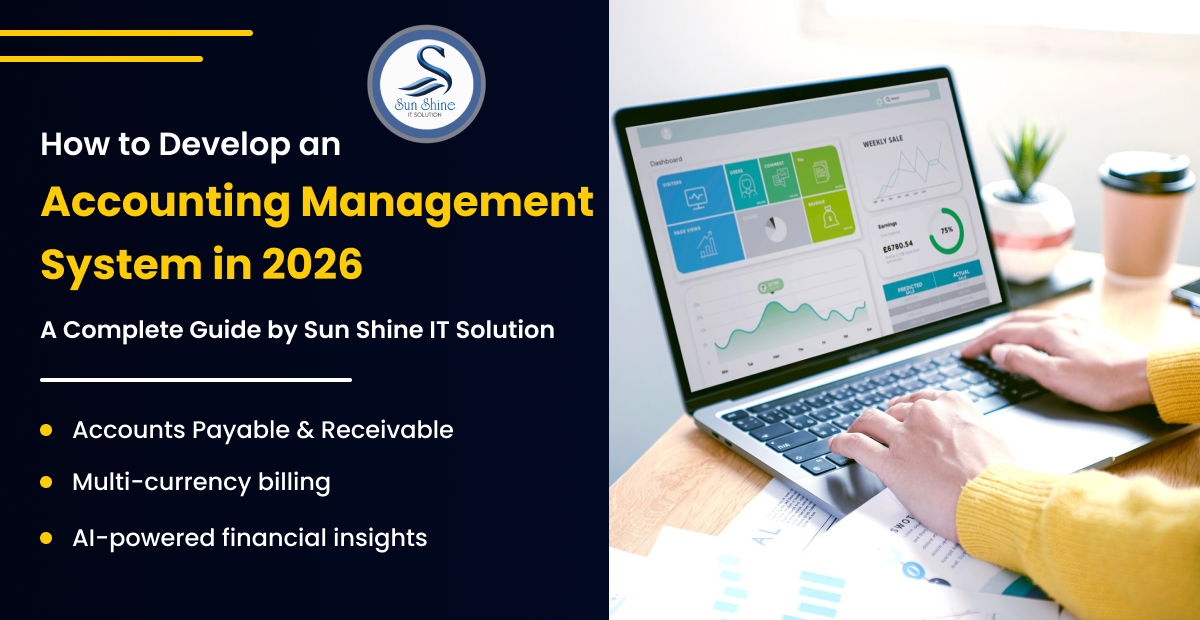
An Accounting Management System (AMS) is a software solution that helps businesses record, manage, track, and analyze financial transactions. It automates core accounting tasks such as bookkeeping, invoicing, payroll, tax calculation, financial reporting, and compliance, enabling organizations to maintain accurate financial records and make informed business decisions.
Why Accounting Management Systems Are Cbritical in 2026
-
Increasing regulatory and tax compliance requirements
-
Demand for real-time financial visibility
-
Growth of remote and global businesses
-
Integration with AI, banking APIs, and ERP systems
-
Need for automation to reduce human error
Sun Shine IT Solution focuses on building future-ready accounting systems that are secure, intelligent, and business-driven.
Key Features of Accounting Management Software
1. Core Accounting Features
-
General Ledger Management
-
Accounts Payable & Receivable
-
Journal Entries
-
Chart of Accounts
-
Bank Reconciliation
2. Invoicing & Billing
-
Custom invoice templates
-
Automated recurring invoices
-
Multi-currency billing
-
Payment tracking
-
GST/VAT-compliant invoices
3. Expense Management
-
Expense categorization
-
Receipt scanning (OCR)
-
Employee reimbursement tracking
-
Approval workflows
4. Payroll Management
-
Salary calculation
-
Tax deductions
-
Payslip generation
-
Compliance with labor laws
-
Integration with attendance systems
5. Taxation & Compliance
-
GST, VAT, TDS, Sales Tax handling
-
Automated tax calculations
-
Tax filing reports
-
Compliance alerts n### 6. Financial Reporting & Analytics
-
Profit & Loss Statements
-
Balance Sheets
-
Cash Flow Reports
-
Custom financial dashboards
-
AI-powered financial insights
7. Automation & AI Features (2026 Ready)
-
Automated data entry
-
Predictive cash flow analysis
-
Anomaly & fraud detection
-
Smart categorization of transactions
8. User & Role Management
-
Role-based access control
-
Multi-user support
-
Audit logs
-
Approval hierarchies
9. Integration Capabilities
-
Bank APIs
-
ERP & CRM systems
-
E-commerce platforms
-
Payment gateways
-
Inventory management systems
10. Security & Data Protection
-
End-to-end encryption
-
Two-factor authentication
-
Regular data backups
-
GDPR & ISO compliance
Types of Accounting Software
1. Desktop-Based Accounting Software
-
Installed on local machines
-
Limited scalability
-
Suitable for small businesses
2. Cloud-Based Accounting Software
-
Accessible from anywhere
-
Real-time data synchronization
-
Highly scalable and secure
-
Preferred choice in 2026
3. Enterprise Accounting Software
-
Designed for large organizations
-
Advanced compliance and reporting
-
ERP integration
4. Industry-Specific Accounting Software
-
Tailored for healthcare, retail, manufacturing, etc.
-
Custom workflows and compliance rules
5. Open-Source Accounting Software
-
Customizable
-
Cost-effective
-
Requires technical expertise
Process to Develop Accounting Management Software
Step 1: Requirement Analysis
-
Identify target users (SMEs, enterprises, startups)
-
Define compliance needs (tax laws, accounting standards)
-
Decide on core and advanced features
Step 2: Market & Competitor Research
-
Analyze competitors like QuickBooks, Xero, Zoho Books
-
Identify feature gaps and innovation opportunities
Step 3: System Architecture Design
-
Cloud-native architecture
-
Microservices-based backend
-
API-first approach
-
Scalable database design
Step 4: UI/UX Design
-
Simple and intuitive dashboards
-
Role-based user experiences
-
Mobile-friendly design
Step 5: Technology Stack Selection
Frontend:
-
React.js / Angular / Vue.js
Backend:
-
Node.js / .NET / Java / Python
Database:
-
PostgreSQL / MySQL / MongoDB
Cloud Platforms:
-
AWS / Azure / Google Cloud
Security:
-
OAuth 2.0
-
JWT authentication
Step 6: Development Phase
-
Modular development
-
API integrations
-
Automation logic implementation
-
AI model integration (if required)
Step 7: Testing & Quality Assurance
-
Functional testing
-
Security testing
-
Performance testing
-
Compliance validation
Step 8: Deployment
-
Cloud deployment
-
CI/CD pipelines
-
Load balancing and monitoring
Step 9: Maintenance & Updates
-
Regular security patches
-
Feature enhancements
-
Compliance updates
Advanced Features to Add in 2026
-
AI-powered financial forecasting
-
Voice-based accounting commands
-
Blockchain-based audit trails
-
Smart tax optimization suggestions
-
Real-time compliance alerts
-
Mobile accounting apps
Challenges in Accounting Software Development
-
Complex tax regulations
-
Data security risks
-
Scalability requirements
-
User adoption and training
Sun Shine IT Solution addresses these challenges with robust architecture, compliance-driven design, and user-focused development.
Benefits of Developing Custom Accounting Software
-
Tailored to business needs
-
Higher data security
-
Competitive advantage
-
Scalable and flexible
-
Better integration with existing systems
Why Choose Sun Shine IT Solution?
-
Expertise in fintech and accounting solutions
-
2026-ready cloud and AI technologies
-
Secure and compliant software development
-
Custom, scalable, and cost-effective solutions
-
End-to-end development and support
Conclusion
Developing an Accounting Management System in 2026 requires a strategic blend of accounting expertise, modern technology, automation, and security. With the right approach and development partner like Sun Shine IT Solution, businesses can build intelligent, scalable, and future-proof accounting software that drives efficiency and growth.